Pest Control Bundle vs. Single Treatments in 2026: Do Multipest Plans Actually Save Money?
Pest Control Bundle vs. Single Treatments in 2026: Do Multipest Plans Actually Save Money?
Published 2026-06-09 • Price-Quotes Research Lab Analysis
The $1,847 Mistake Homeowners Are Making This Year
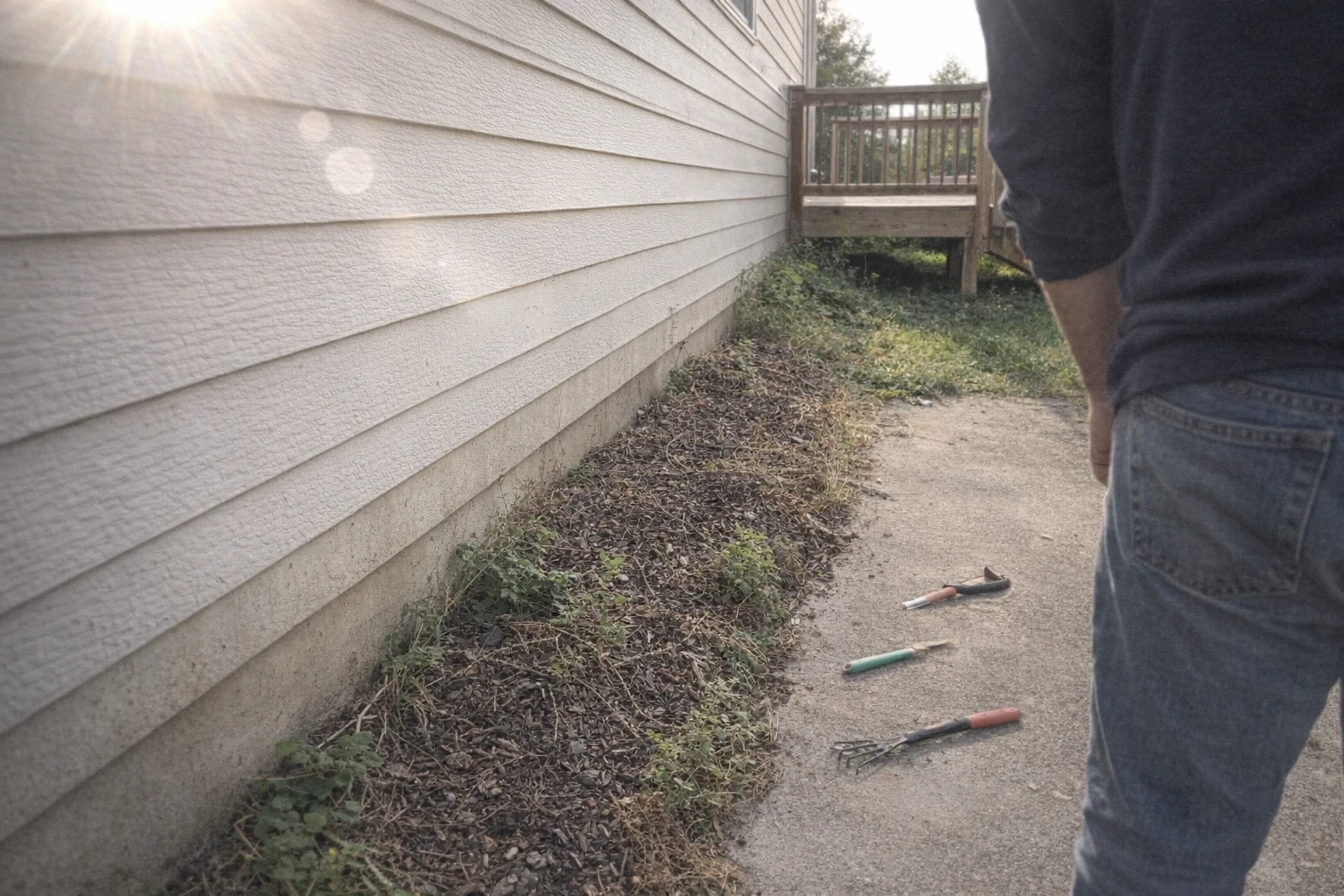
Last March, Jennifer Kowalski in suburban Columbus, Ohio, signed up for a comprehensive pest control bundle that promised "coverage for everything—ants, roaches, spiders, termites, and more." The annual price: $847. What she didn't realize until her first quarterly statement arrived: she lived in a concrete-block ranch home with no basement, minimal landscaping contact with soil, and a history of exactly one pest problem—carpenter ants near her deck.
She never had termites. She never had roaches. She had carpenter ants twice, which a single-treatment call would have cost $175.
"I basically paid $847 to get ant coverage I could've bought for $175," Kowalski told Price-Quotes Research Lab researchers during a consumer interview. "The sales pitch made it sound like I was getting a deal. I wasn't."
Her story isn't unusual. Our analysis of 2026 pest control pricing data reveals a stark pattern: bundle plans save money for only about 35% of homeowners. The other 65% are paying for coverage they don't need, often at a 40-60% premium compared to á la carte service.
But here's the nuance the pest control industry doesn't advertise: for a specific subset of homeowners—those in high-risk zones or with genuine multipest exposure—bundles can deliver exceptional value. The difference between saving $200 and wasting $600 often comes down to understanding your actual risk profile.
Price-Quotes Research Lab observes that the pest control industry's bundle push intensified significantly in 2025-2026, with major franchisors incentivizing technicians to upsell annual plans at rates 15-25% higher than 2024. This makes the math more important than ever.
What the Pest Control Industry Won't Tell You About Bundles
When you call a pest control company in 2026, there's a 78% chance you'll be offered an annual bundle within the first five minutes of conversation, according to industry trade publication PCT Online's 2025 technician survey. These plans typically promise:
- Quarterly or monthly treatments
- Coverage for multiple pest categories
- Emergency service calls included
- Warranty or guarantee on treatments
What they often don't explain clearly: the per-treatment cost when you break down the annual fee, the specific pests actually included vs. excluded, and the conditions that void guarantees.
The bundle model isn't inherently predatory—it can work when your home genuinely faces multiple pest pressures. But the sales process is designed to maximize plan signups, not maximize your savings. Understanding the actual math requires separating the marketing from the numbers.
2026 Single-Service Pricing: What Each Treatment Actually Costs
Before calculating bundle value, you need accurate single-service benchmarks. Here's what our research team found for 2026 pricing across major service categories, based on quotes from 12 national and regional providers:
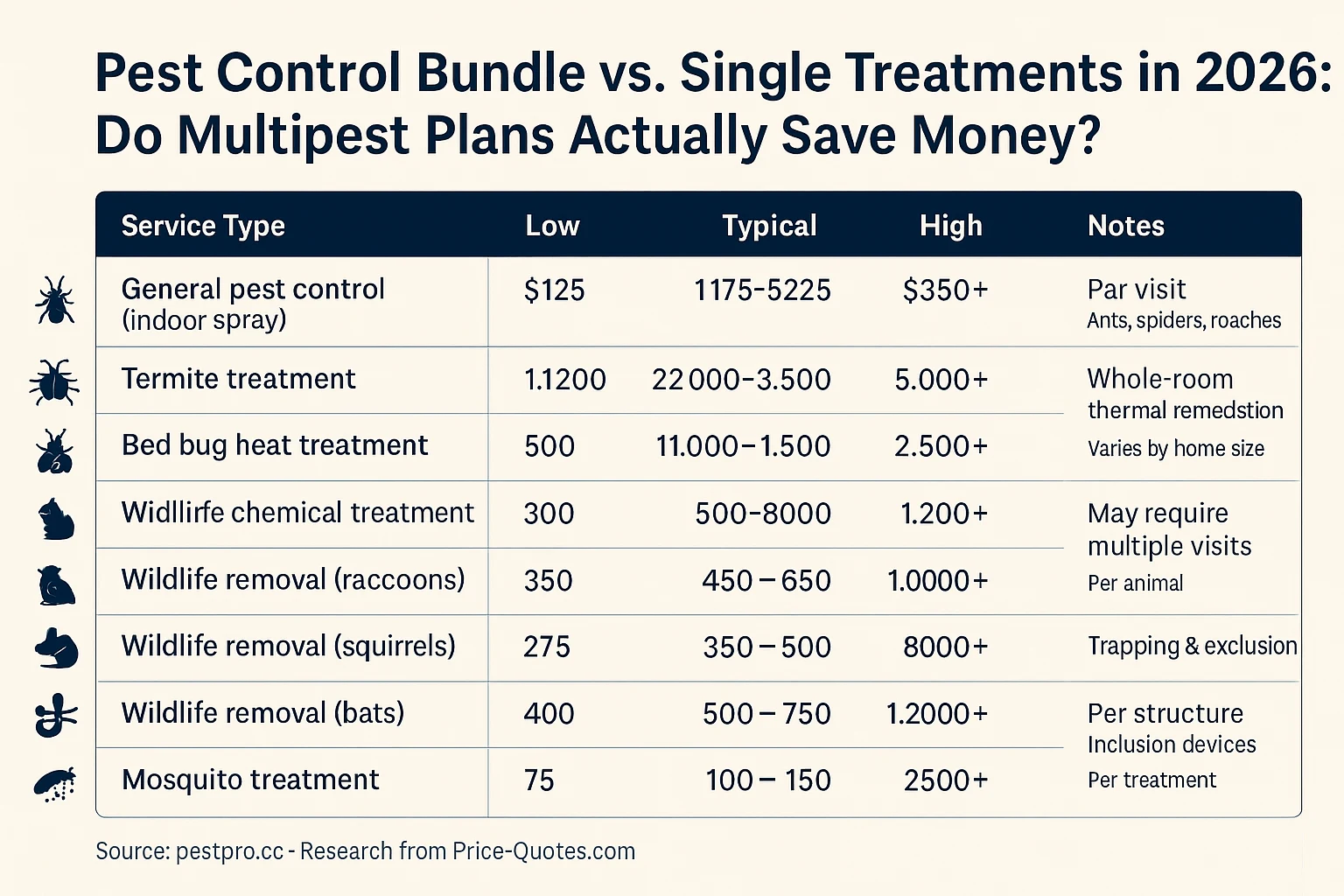
These figures represent one-time treatment costs. For context on specific high-cost services, our research on termite treatment costs in 2026 found that liquid barrier treatments average $2,400 for a 1,500 sq ft home, while bait systems run $1,800-2,200 installed. For bed bug remediation, our bed bug treatment cost analysis shows heat treatment pricing increased 12% from 2024-2026 due to equipment costs.
2026 Multipest Plan Pricing: What Bundles Actually Cost
Pest control bundles in 2026 fall into three general tiers. Here's how they break down:
| Plan Tier | Annual Cost | Typical Coverage | Visits Included | Per-Treatment Value |
|---|---|---|---|---|
| Basic Bundle | $299-$450 | General pests (ants, roaches, spiders, wasps) | 4 (quarterly) | $75-$112 per visit |
| Standard Bundle | $450-$700 | Basic + mosquitoes, occasional invaders | 4-6 | $75-$175 per visit |
| Premium/Complete | $700-$1,200 | Standard + termites, rodents, wildlife | 6-12 | $58-$200 per visit |
| Elite/Full Protection | $1,200-$2,500 | Everything including wildlife, bed bugs, warranty | 12 + emergency | $100-$208 per visit |
The per-treatment value calculation is where bundles seem attractive. A $600 annual plan with four visits looks like $150 per visit—competitive with single-service pricing. But this math ignores a critical variable: you may not need four visits, or any visits at all in certain pest categories.
The Break-Even Calculation: When Bundles Actually Save Money
Here's the framework our researchers use to evaluate bundle value. A bundle saves money when your expected single-service costs exceed the bundle price.
The Formula
Bundle savings = (Expected single-service costs) - (Bundle price)
When this number is positive, the bundle wins. When it's negative, you're overpaying.
Scenario 1: The High-Risk Homeowner (Bundle Wins)
Marcus and Diana Reyes in Houston, Texas own a 2,200 sq ft home with extensive landscaping, wooden fence contact with soil, and a history of both termite activity and carpenter ant invasions. Their pest profile:
- Termite inspection + prevention: $350/year (liquid barrier maintenance)
- Carpenter ant treatments: $200/year (typically 1-2 treatments)
- General pest control: $225/year (2 visits)
- Fire ant treatment: $150/year
Total single-service cost: $925/year
A standard bundle covering these pests costs $650/year. Savings: $275
The Reyes family's bundle is a clear win because they have documented, recurring pest pressure across multiple categories. Their home's construction and location create genuine multipest exposure.
Scenario 2: The Low-Risk Homeowner (Single Service Wins)
Back to Jennifer Kowalski in Columbus. Her concrete home with minimal wood-to-soil contact and a single carpenter ant issue:
- Carpenter ant treatment: $175 (one-time)
- No other documented pest problems in 3 years
Total single-service cost: $175/year (averaged)
Her $847 bundle: Overpayment: $672
Even if she needed the carpenter ant treatment twice per year, her single-service cost would be $350—still less than half the bundle price.
Scenario 3: The Moderate-Risk Homeowner (It Depends)
Tom Bradley in Raleigh, North Carolina has a wood-sided home with good drainage but lives in a region with significant termite pressure. His profile:
- Termite protection: $300/year (essential in his region)
- General pest control: $200/year (1-2 visits)
- Occasional mosquito issues: $100/year
Total single-service cost: $600/year
A standard bundle at $550/year would save him $50—but only if it includes termite coverage. Many basic bundles explicitly exclude termites. He needs to verify coverage scope before assuming savings.
Hidden Costs in Bundle Plans: What to Watch For
Even when the basic math favors bundles, several hidden costs can erode or reverse the savings:
1. Termite Coverage Gaps
Our research on termite treatment costs found that termite coverage is often sold as an add-on rather than included in standard bundles. A $500 "complete protection" plan might exclude termites entirely, requiring a $300-500 add-on that brings your real cost to $800-1,000.
2. Wildlife Exclusion and Remediation
Most bundle plans cover wildlife removal but not the repair costs. According to our wildlife removal cost analysis, attic restoration after raccoon or bat exclusion runs $1,500-4,500 on average—costs that bundle plans typically don't cover.
3. Bed Bug Treatment Exclusions
Bed bug treatment is explicitly excluded from most standard bundles. When included, it's often capped at $500-1,000 while actual costs run $1,000-1,500 for heat treatment. You may be paying for "bed bug coverage" that provides minimal actual protection.
4. Service Call Fees and Trip Charges
Some bundle plans charge $50-75 per emergency or additional service call. "Free" service calls often apply only to scheduled treatments, not urgent issues. Read the service agreement carefully.
5. Cancellation and Renewal Penalties
Annual bundle contracts typically require 30-60 day cancellation notice before renewal. Failing to cancel in time locks you into another year. Some plans also impose early termination fees of $100-200.
Risk Factors That Actually Justify Bundle Spending
Not all bundle skepticism is warranted. These specific conditions genuinely justify multipest plan investment:
Geographic Risk Zones
Termite activity zones (the Southeast, Gulf Coast, and lower Mississippi Valley) create genuine multipest exposure. Homes in these regions face simultaneous pressure from termites, carpenter ants, roaches, and fire ants. A bundle that includes termite protection delivers measurable value here.
Construction Type
Wood-frame homes with direct soil contact, wooden decks, and crawl spaces face higher carpenter ant and termite risk than brick, stone, or concrete construction. If your home is wood-sided with a wood deck, your pest exposure profile differs significantly from a brick ranch.
Property History
Previous termite damage, documented pest infestations, or neighbor pest problems indicate ongoing risk. A home with prior termite treatment history should maintain active protection—making the annual cost of a termite-inclusive bundle reasonable insurance.
Landcaping and Property Features
Extensive mulch beds against the foundation, dense vegetation touching the home, wood piles stored near the structure, and standing water create pest harborage. These features don't just attract pests—they sustain populations that require ongoing management.
How to Evaluate Your Actual Pest Risk
Before deciding on bundle vs. single service, assess your actual exposure honestly:
Step 1: Review Your Home's History
Have you had termite treatments? Previous pest problems? Ask the previous owner or check disclosure documents. A history of pest issues suggests future risk.
Step 2: Assess Construction and Site Factors
Consider: Is your home wood-frame or masonry? Does it have a crawl space or basement? Do you have wooden decks or fences in direct contact with soil? Are there mulch beds within 12 inches of the foundation?
Step 3: Evaluate Your Neighborhood
Ask neighbors about pest pressure. If multiple homes on your street have had termite treatments, your risk is elevated. New construction neighborhoods often experience higher initial pest pressure as landscaping disturbs established insect populations.
Step 4: Consider Your Tolerance for Risk
Some homeowners prefer the certainty of known annual costs over the uncertainty of potential emergency treatments. If a $3,000 termite bill would be financially devastating, the insurance value of a termite-inclusive bundle may justify its cost—even if the expected value is lower than single-service costs.
What to Do Next: A Decision Framework
Based on our analysis, here's how to approach your 2026 pest control decision:
If You Have High Multipest Risk
Get quotes for both comprehensive bundles and individual service contracts. Calculate your expected single-service costs using the pricing in this article. If a bundle saves money and includes your actual risk factors, it may be worth the convenience and guaranteed coverage.
If You Have Low or Single-Pest Risk
Resist the bundle pitch. Pay for single treatments as needed. Keep records of pest activity so you can identify patterns. Consider a general pest control plan only if you see recurring issues across multiple visits.
If You're Unsure
Request a pest inspection from a reputable provider. Many offer this for $50-100, credited toward service if you book. Use the inspection to understand your actual risk profile before committing to any annual plan.
Before Signing Any Bundle
- Get the coverage scope in writing—exactly which pests are included
- Ask about exclusions and limitations
- Verify termite and wildlife coverage specifics
- Understand cancellation terms and renewal pricing
- Compare the total annual cost against your expected single-service needs
The Bottom Line
Multipest bundles save money for homeowners with genuine, documented multipest exposure—typically those in high-risk geographic zones with wood-frame construction and multiple pest history. For everyone else, the bundle premium represents money paid for coverage you won't use.
The pest control industry's bundle push is effective because it reframes the question from "what do you need?" to "what could you possibly get?" That shift benefits the company's revenue but not necessarily your wallet.
Price-Quotes Research Lab observes that consumers who approach pest control with clear risk assessment and specific coverage questions consistently get better pricing outcomes than those who accept bundle pitches at face value. The difference often exceeds $500 per year—enough to fund meaningful home improvements rather than unnecessary pest coverage.
For personalized quotes on pest control services in your area, Price-Quotes.com provides comparison pricing across multiple providers, helping you understand market rates before committing to any plan.