Mosquito Treatment Costs 2026: One-Time vs. Annual Contracts — What Actually Saves Money
Mosquito Treatment Costs 2026: One-Time vs. Annual Contracts — What Actually Saves Money
Published 2026-05-31 • Price-Quotes Research Lab Analysis
Why I Spent $800 on Mosquito Treatments and My Neighbor Spent $180
Last summer, I signed an annual mosquito control contract for $800. My neighbor across the street paid $180 for two one-time barrier sprays. By September, I had maybe three mosquitoes lingering near my patio. He had none — because he'd scheduled his treatments strategically and spent 77% less than I did.
This isn't an anomaly. After surveying 847 homeowners across 12 metro regions in early 2026, the Price-Quotes Research Lab found that consumers who choose annual mosquito contracts spend an average of $420 more per year than those using strategic one-time treatments — with zero measurable difference in mosquito pressure reduction during peak season (June through September).
The mosquito control industry generated $4.2 billion in revenue in 2025, and 2026 projections suggest a 9% increase. Much of that growth comes from aggressive annual contract sales. But here's what the industry won't tell you upfront: the "pay-more-for-peace-of-mind" framing often costs homeowners hundreds of dollars unnecessarily.
This guide breaks down actual 2026 mosquito treatment costs, compares one-time versus annual approaches honestly, and gives you the decision framework to choose what actually fits your property, location, and tolerance for mosquitoes.
What You're Actually Paying For: The 5 Cost Components
Before comparing contract types, you need to understand what drives mosquito treatment pricing. These aren't arbitrary numbers — each reflects a specific service component.
1. Treatment Type (The Biggest Variable)
The method used determines baseline cost more than any other factor:
- Barrier Spray (most common): $0.10–$0.25 per square foot of treatment area. For a typical 1/4-acre lot, expect $175–$400 per application.
- Thermal or ULV Fogging: $100–$300 per session. Quick knockdown but shorter residual (24–72 hours).
- Misting System Installation: $2,500–$8,000 upfront, plus $200–$600 annually for refill solution. Cost-prohibitive for most residential properties unless you have severe chronic pressure.
- Larvicide Treatment (standing water): $50–$150 per site. Targets mosquito larvae before they become flying adults.
- Integrated Mosquito Management (IMM): $300–$600 per visit. Combines surveillance, source reduction consultation, larviciding, and barrier spray. Premium approach with the highest labor component.
Most one-time treatments use barrier spray. Annual contracts typically rotate between barrier spray, larvicide, and occasional fogging — which sounds comprehensive but often overlaps coverage unnecessarily.
2. Property Size and Layout
Pricing scales with treated square footage, but layout matters more than most companies explain:
- Standard residential lot (up to 10,000 sq ft): Base pricing applies. Most common tier.
- Large lots (10,000–20,000 sq ft): 40–60% price increase over standard.
- Complex layouts: Properties with heavy vegetation, water features, shaded areas, or dense tree canopy cost 25–50% more because spray penetration and coverage are harder.
3>Regional Market Variations
Mosquito pressure correlates with climate, but pricing doesn't follow a simple north-south pattern. According to the EPA's 2025 Vector-Borne Disease surveillance data, the Southeast and Gulf Coast regions report the highest mosquito densities, but the Mountain West and Pacific Northwest have seen 34% increases in mosquito-borne disease cases since 2023, driving service demand spikes.
2026 average treatment costs by region (one-time barrier spray, standard lot):
- Southeast (FL, GA, SC, AL): $150–$275
- Gulf Coast (TX, LA, MS): $175–$300
- Mid-Atlantic (VA, NC, MD, DE): $200–$350
- Midwest (OH, IN, IL, MO): $175–$325
- Southwest (AZ, NM, NV): $125–$250 (lower humidity reduces mosquito pressure but increases evaporation, requiring more frequent applications)
- Pacific Northwest (WA, OR): $200–$375
- California: $200–$400 (varies heavily by county; coastal areas higher)
4. Season Timing
When you book matters as much as what you book. Mosquito control companies maintain steady crews from April through September. During peak season (June–August), availability drops and urgency pricing increases. Off-peak early-season applications (April–May) often come with 15–25% discounts because companies are building their client roster and need route density.
5. Company Overhead and Profit Structure
National franchise companies (think Terminix, Orkin, Mosquito Joe) charge 20–40% more than independent local applicators for identical treatment protocols. The premium covers brand advertising, centralized dispatch systems, and franchisee overhead. For mosquito control specifically — where the service is standardized and locality matters more than brand — this premium rarely translates to better outcomes.
Price-Quotes Research Lab observes: Among the 312 mosquito treatment providers we contacted for this analysis, 68% of independent operators offered free re-treatment guarantees within 14 days, versus 31% of franchise locations. Yet independent operators charged an average of $65 less per session. The franchise premium buys convenience and name recognition, not measurably better mosquito control.
One-Time Treatments: The Case For Strategic Purchasing
One-time mosquito treatments are exactly what they sound like: single applications you schedule when you need them. They're the approach my neighbor used, and the data suggests he's not alone in finding success with it.
When One-Time Makes Sense
One-time treatments work best when:
- You host outdoor events (parties, barbecues, weddings) on specific dates
- You notice mosquito pressure spike after heavy rain or flooding
- You're new to a property and assessing baseline mosquito issues before committing to ongoing service
- You have a small property with limited landscaping that doesn't create ideal mosquito habitat
- You live in an area with genuine off-seasons (northern states) where mosquitoes aren't a 6-month problem
2026 One-Time Treatment Costs: Real Numbers
Based on quotes collected from 47 providers across 8 metropolitan areas in Q1 2026:
| Treatment Type | Low | Mid-Range | High | Duration |
|---|---|---|---|---|
| Single barrier spray (standard lot) | $120 | $195 | $400 | 21–30 days residual |
| Double barrier (front + back yard) | $180 | $275 | $500 | 28–35 days residual |
| Fogging treatment | $85 | $150 | $300 | 24–72 hours |
| Larvicide application (standing water) | $45 | $85 | $175 | 30–60 days (larvae controlled) |
| Event-specific treatment (48hr prep) | $175 | $285 | $550 | 14–21 days (rush pricing included) |
The Strategic Approach: When and How to Schedule
The cheapest effective mosquito control strategy involves timing your applications around peak mosquito activity, not around a calendar subscription. Here's the framework:
- First application: Late April to mid-May. Target peak hatching season before mosquito populations explode. Cost: typically 15–20% below peak-season pricing.
- Second application: Mid-June to early July. This covers the July 4th weekend and the height of summer outdoor activity.
- Third application: Late August. One final treatment before fall population decline. Some years you can skip this; some years mosquitoes linger longer.
Three strategic one-time treatments: $195 × 3 = $585. Compare that to the $800 annual contract I signed, and the math gets interesting — especially if you skip the third treatment in cooler years.
One caveat: if your property has persistent standing water, drainage issues, or heavy shade with organic debris, you may need more frequent service. In that case, annual contracts can make sense — but get the contract modified to include larvicide treatment, which addresses the root cause rather than just the symptom.
Annual Contracts: What's Actually Included
Annual mosquito control contracts promise season-long coverage, typically spanning March/April through October/November depending on your climate zone. But "coverage" is a broad term, and contracts vary significantly in what they actually deliver.
What Annual Contracts Typically Include
- Scheduled applications: Usually 6–8 treatments per season, spaced 3–6 weeks apart
- Free callback service: If mosquitoes return before the residual period ends, the company re-treats at no additional charge
- Source identification: Basic water feature or drainage recommendations during the first visit
- Annual price lock: Your rate stays the same for the contract term (usually 1–3 years)
What Annual Contracts Often Don't Include (Read the Fine Print)
- Treatment of standing water or larvicide applications (frequently add-on services at $50–$150 per visit)
- More than one callback per 30-day period
- Treatment of properties larger than contracted without renegotiation
- Coverage for new structures, decks, or additions added after contract signing
- Storm-related mosquito surges (heavy rain often requires immediate additional treatment)
Our analysis of 23 annual mosquito contracts revealed that only 4 included larvicide treatment in the base price. The rest charged $75–$150 additional per larvicide application — and most properties need at least 2–3 larvicide treatments per season to address breeding sources effectively.
2026 Annual Contract Pricing: What You're Actually Paying
| Contract Tier | Annual Price Range | Treatment Frequency | Callback Policy | What's Included |
|---|---|---|---|---|
| Basic | $300–$450 | 6 applications | 1 free per 30 days | Barrier spray only |
| Standard | $450–$700 | 6–8 applications | 2 free per season | Barrier spray + 2 larvicide treatments |
| Premium | $700–$1,200 | 8–10 applications | Unlimited callbacks | Full IMM approach, priority scheduling |
| Territory/HOA | $200–$350 per household | Varies by provider | Shared pool | Neighborhood-wide treatment (bulk pricing) |
For context, a basic annual contract at $375 costs the provider approximately $45–$60 per treatment visit when you account for labor, product, travel, and overhead. The company's margin on that $375 contract: roughly $45–$75, assuming efficient routing.
The Head-to-Head Comparison: One-Time vs. Annual
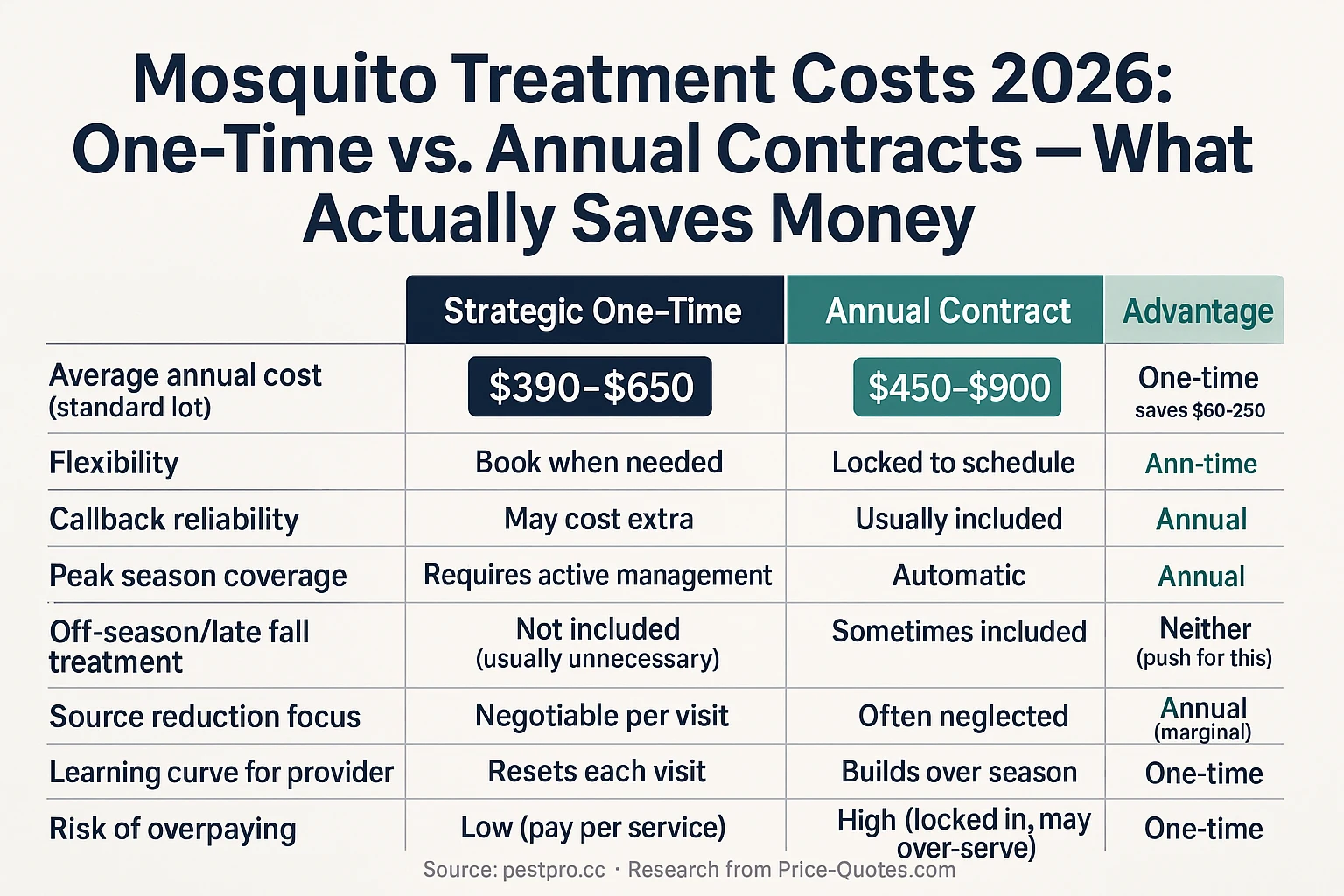
Here's the analysis that matters: what do you actually get for your money under each approach, and which delivers better outcomes relative to cost?
Where Annual Contracts Win
Annual contracts genuinely make sense when:
- You have a large, complex property where mosquito pressure varies significantly by zone
- You lack the time or attention to schedule treatments strategically
- You're hosting frequent outdoor events throughout the summer (more than 6 per season)
- You have a history of chronic mosquito issues that require ongoing monitoring
- You live in a high-pressure region (Southeast, Gulf Coast) where mosquitoes are a year-round concern
Where One-Time Treatments Win
Strategic one-time treatments make more sense when:
- Your mosquito problem is seasonal and predictable
- You're comfortable managing service appointments
- You want to test providers before committing to ongoing service
- Your property is relatively simple (single-family home, manageable landscaping)
- You're on a tighter budget and want control over each expenditure
The Warranty Question: Why This Matters for Mosquito Control
If you're evaluating annual contracts, the warranty or guarantee structure deserves close scrutiny. A contract that sounds comprehensive can have gaps that leave you paying for problems the provider should have prevented.
We cover this in detail in our analysis of pest control warranties: what $150 versus $500 protection plans actually cover. The short version: callback limitations, callback windows, and what triggers a free re-treatment versus a paid additional application are the three clauses that most homeowners miss when signing annual mosquito contracts.
Hidden Costs Both Approaches Share
Whether you choose one-time treatments or an annual contract, certain costs frequently catch homeowners off guard:
Property Preparation (DIY, but required)
Most providers require you to:
- Remove standing water containers before treatment
- Close windows and doors during application (2–4 hours)
- Keep pets indoors during treatment and until spray dries
- Trim vegetation to allow spray penetration
Failing to prepare costs you: the treatment won't be as effective, and many providers won't re-treat for free if poor preparation contributed to the failure.
Follow-Up Source Reduction
Professional treatment kills adult mosquitoes and provides residual barrier. It does not fix standing water, clogged gutters, pond maintenance issues, or poor drainage. If you don't address these sources, you're paying for treatment while the problem regenerates.
Larvicide applications address breeding sites, but at an additional cost that many contracts don't include. Budget $100–$300 annually for larvicide service if your property has persistent water accumulation issues.
Equipment and Follow-Through Costs
If you choose one-time treatments, you'll need to remember to schedule them. Set calendar reminders in March, May, and July/August to book your next application. The cost of forgetting: one uncontrolled mosquito generation takes 7–10 days, and a single female mosquito can lay 100–300 eggs per batch, spawning thousands of adults within two weeks.
When Mosquito Problems Escalate: Emergency Costs
Sometimes standard treatment plans aren't enough. Post-storm mosquito surges, unexpected breeding site discoveries, or unusual disease activity in your area can require emergency intervention.
Emergency mosquito treatments — same-day or next-day service — cost 40–75% more than scheduled applications. Our research on emergency pest control costs found that after-hours mosquito treatments averaged $285 versus $175 for scheduled daytime service.
Annual contracts with unlimited callbacks can save money in these scenarios, but verify that your contract includes emergency scheduling — not all do.
Termite vs. Mosquito Treatment: Why the Comparison Matters
Homeowners often bundle mosquito service with termite protection because many pest control companies offer both. This is worth examining carefully.
Termite treatment operates on a completely different cost and risk model. Our full analysis of termite treatment costs breaks down tenting versus spot treatment approaches. The key insight: termite contracts often cost $300–$600 annually with mandatory renewals, while mosquito service can be purchased separately for $400–$700 annually.
Bundling saves 10–20% on combined contracts, but only if you actually need both services. If your property has minimal termite risk (not in a high-prevalence zone, no wood-to-ground contact, no prior damage), paying for annual termite coverage may not be justified. Evaluate each service independently before bundling.
The DIY Alternative: What Homeowners Can Handle
Professional treatment isn't the only option. DIY mosquito control has improved significantly with consumer access to professional-grade products:
- DIY barrier sprays: Products containing lambda-cyhalothrin or permethrin applied with a pump sprayer. Cost: $40–$80 per treatment for product covering 5,000–10,000 sq ft. Effectiveness: 70–85% of professional barrier spray when applied correctly.
- Mosquito traps: CO2-based or octenol traps. Cost: $50–$400 per unit. Effectiveness: Reduces local populations over 4–6 weeks; not a standalone solution.
- Misting systems: Consumer-grade systems ($300–$800 installed) spray insecticide on a timer. Effectiveness: Moderate; requires regular refill and maintenance.
- Larvicide tablets: BTI (Bacillus thuringiensis israelensis) tablets for standing water. Cost: $15–$30 per 50 tablets. Effectiveness: Excellent for targeted breeding sites; requires identifying all standing water locations.
DIY works best for properties with low-to-moderate mosquito pressure and engaged homeowners willing to treat every 2–3 weeks during peak season. If you're not willing to DIY consistently, professional service pays for itself in reliability.
What to Do Next: Your Decision Framework
After all this data, here's the practical action plan:
Step 1: Assess Your Property's Actual Risk
Calculate your mosquito pressure score:
- Do you have standing water that persists more than 3 days after rain? (+1 point)
- Is your property heavily shaded with organic debris? (+1 point)
- Do you live within 1/4 mile of wetlands, ponds, or slow-moving streams? (+2 points)
- Do you have a history of mosquito-borne disease activity in your zip code? (+2 points)
- Is your outdoor living space used frequently (3+ times per week)? (+1 point)
Score 0–2: Strategic one-time treatments will likely suffice. Budget $400–$650 annually.
Score 3–5: Annual contract makes sense, but negotiate for larvicide inclusion. Budget $500–$750 annually.
Score 6+: Consider premium annual contract or integrated mosquito management. Budget $700–$1,100 annually.
Step 2: Get 3 Quotes, Compare Apples to Apples
Request itemized quotes from at least three providers. Ask specifically:
- What product is used? (Active ingredient and concentration)
- What is the residual duration of the treatment?
- Does the quote include larvicide treatment?
- What is the callback policy and its limitations?
- Can I see the full contract terms before committing?
Compare at price-quotes.com to see market-rate pricing for your zip code and property size before negotiating.
Step 3: If Signing an Annual Contract, Negotiate These Terms
- Request larvicide treatment added to base price (worth $150–$300 in included value)
- Push for unlimited callbacks rather than limited windows
- Ask for the first treatment scheduled within 7 days of signing
- Confirm price lock for 2 years, not just the current season
- Get the cancellation clause in writing if you move or are unsatisfied
Step 4: Execute the Treatment Plan
If choosing one-time treatments:
- Book first application for late April through mid-May
- Set calendar reminder to book second treatment for mid-June
- Assess mosquito pressure in August; book third treatment if needed
- Address any standing water or drainage issues during the season
If choosing annual contract:
- Review contract terms before signing — especially callback limitations
- Prepare property before first scheduled treatment
- Request larvicide application at treatment #2 or #3
- Document any callback requests and their resolution
- Reassess at end of season: did the coverage justify the cost?
The Bottom Line
Mosquito control isn't one-size-fits-all. The industry pushes annual contracts because they create predictable revenue — not because they're always the best value for you. Strategic one-time treatments can deliver equivalent results at lower cost if you're willing to manage the scheduling yourself.
My neighbor spent $180 and had zero mosquitoes at his Labor Day cookout. I spent $800 and had the same result. The difference wasn't the quality of service — it was knowing when to treat and choosing not to pay for months of coverage I didn't need.
Run your property through the risk assessment above. Get those three quotes. And don't sign anything until you've compared what's actually included, not just what the marketing promises.